My friend asked me about some old Japanese records. He said they were records his family, the first generation of Japanese immigrants, we called it Issei, brought to Canada. It sounded interesting, so I decided to look into it!
I got a total of 10 records, so I’ve decided to write about them in several separate articles. Please check out the other pages if you’re interested!
For the given name, see Issei (given name).
The first Japanese immigrants arrived in Brazil aboard the Kassato Maru in 1908.[1] They referred to themselves as issei and became known as Nipo-Brasileiros.
Written by Wikipedia
Issei (一世, “first generation”) are Japanese immigrants to countries in North America and South America. The term is used mostly by ethnic Japanese. Issei are born in Japan; their children born in the new country are nisei (ni, “two”, plus sei, “generation”); and their grandchildren are sansei (san, “three”, plus sei, “generation”).
Tankai-bushi / 淡海節

What did you see on the record?
| Record label | Victor |
| Title | Tankai-bushi / 淡海節 |
| Singer | Eiken Akashi, Hikaru Miki(or Mikihikaru) / 明石栄検 みき光 |
| Instruments | Shamisen |
| Format | 78rpm |
Here is “record player revolutions per minute explanation”
Understanding the Title: Reading rule of Japan
At first, I could not read the title. My confusion ended when I noticed the position of the character “bushi” (節). That was when I realized that the title had to be read from right to left. In other words, the correct reading is Tankai-bushi.
This reflects an older convention in Japanese typography.
As you may know, traditional Japanese was primarily written vertically. Writing started at the upper right corner of the page, and each subsequent line proceeded to the left of the previous one. According to the Tokyo Printing Museum, the modern convention of reading horizontally written Japanese from left to right did not become widespread until after World War II.
横書きの書字方向を統一した方が良い、というのは万人の意見だったものの、どちらにするかについては意見が分かれました。しかし、特定の分野では明治期から左横組みが定着していたことや、アラビア数字との相性の良さ、また手書きの場合、左から右へ書く方がスムーズであるということから、統一するならば左横書きへというのが自然の流れでした。
(中略)
左横書きが定着するのは、戦後になってからでした。しかしそれは内閣告示や訓令を通じてではなく、自然の成り行きでした。終戦から3年あまりの間に左横書きへの変化が一気に起こり、1950年頃には右横書きを駆逐してしまったようです。戦時中に左横書きは「欧米化=けしからん」でしたが、今度は同じ左横書きが「欧米化=近代的かつ新時代」という理由で歓迎されたのかもしれません。
印刷博物館(いんさつはくぶつかん) ~日本語の文字組みについて
In Japan, the direction of writing can still feel complex. Books may open from the right or from the left, and vertical writing begins on the right side of the page. Japanese students gradually learn these conventions during their elementary school years.
Background of Tankai-bushi / 淡海節 : yearning for a taste of refinement
Tankai-bushi is a folk-style song from Shiga Prefecture. Despite its traditional sound, it is not an especially old song.
The piece is generally classified as an Ozashiki song. It is said to have been written and composed by the comedian and entertainer Shiganoya Tankai, although some sources suggest that the lyrics may have been written by someone else.
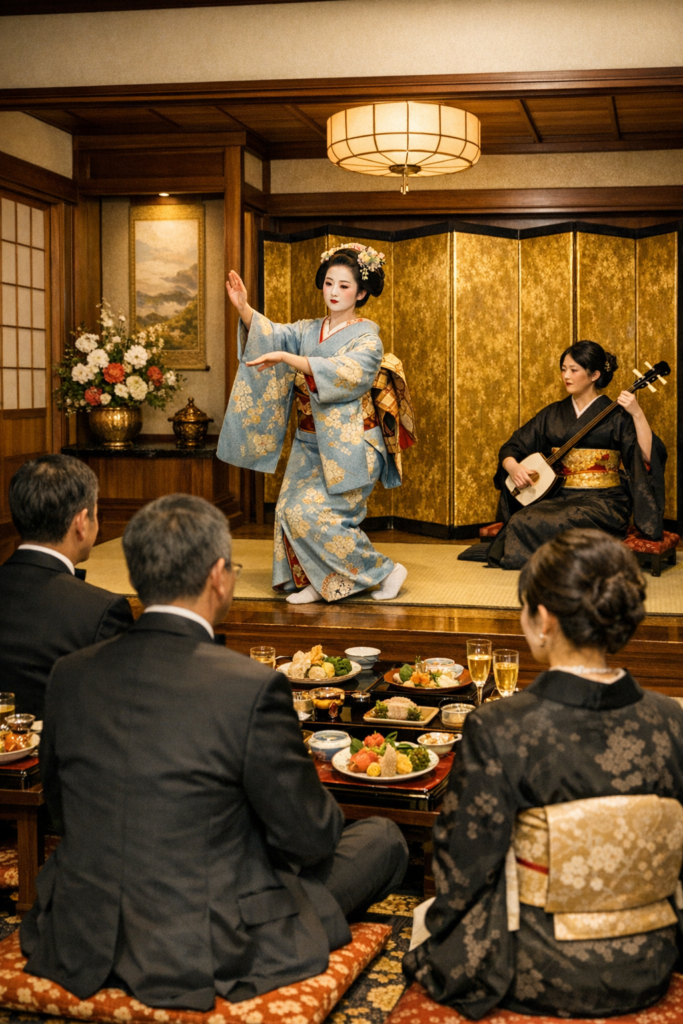
Q: What is an Ozashiki song?
The term ozashiki refers to a traditional banquet setting where guests are entertained by professional performers such as geisha.
An ozashiki song (ozashiki uta) is a song performed in this environment. These songs were typically sung by geisha to entertain guests at private gatherings. Because of the nature of the setting, the performance style often emphasizes elegance, emotional expression, and refined technique.
For readers unfamiliar with this cultural setting, the following video provides a helpful introduction to how an ozashiki gathering typically unfolds. It shows the atmosphere of a traditional banquet, including conversation, games, and musical performances by geisha, offering a glimpse into the setting where ozashiki songs were originally performed.
About the performers: How to Interpret Akashi Eiken (明石榮検)
Unfortunately, detailed information about these performers is difficult to obtain and would require further archival research. However, the information printed on the record allows us to consider several possibilities.
In traditional Japanese performing arts, performers frequently use stage names. These names may be inherited from a teacher or master, or they may reflect the name of a particular school or lineage.
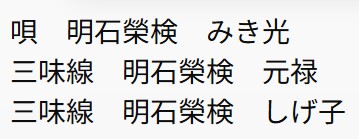
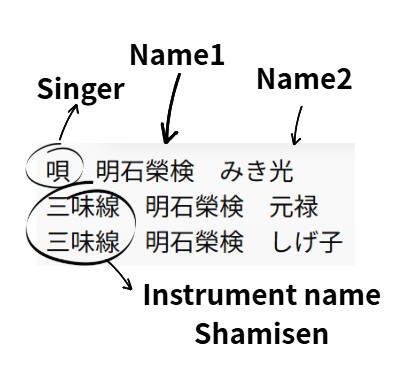
Looking closely at the label, we notice that the name Akashi Eiken (明石榮検) appears before what seem to be the individual names of the performers.
There are several possible interpretations of the character “ken” (検):
Hypothesis 1: Akashi Eiken
“Akashi” is likely the surname, and “Eiken” may be a stage name used by the performer.
Hypothesis 2: Akashi Ei(or Sakae) +Ken
In this interpretation, “Ken” could be an abbreviation of Kengyō, a historical title given to high-ranking blind musicians in traditional Japanese music. The name would then combine the characters “Ei” (榮) and “Ken”(検) to indicate both personal identity and professional rank.
Hypothesis 3: Akasieiken
“Akashieiken (明石榮検)” may represent the name of a school or performing lineage, rather than an individual person.
If one performer both sang and played the shamisen, the label would normally indicate this clearly. However, because the record lists separate performers, it is unlikely that a single person performed both roles.
For this reason, the third interpretation—the possibility that Akashi Eiken refers to a school or artistic lineage—may be the most plausible explanation at present.
Another possibility is that these musicians were affiliated with the record company’s studio performers, but this remains uncertain.
Conclusion: Tankai-bushi and the Issei Listener
At first glance, it might be easy to dismiss Tankai-bushi as merely a simple folk-style song. However, it appears to have been a popular piece in its time and is sometimes classified as an Ozashiki song.
Even though detailed historical information is limited, the record itself tells an important story.
At some point, someone chose this record in Japan and brought it with them across the Pacific to Canada—long before online shopping or easy international shipping existed.
The owner probably did more than simply listen to it. Tankai-bushi is not an easy song to perform, and its melodies invite participation. It is easy to imagine the record’s owner singing along, perhaps during gatherings with friends or fellow immigrants.
If so, the person who owned this record was likely not only a listener, but also a confident and skilled singer.
コメント